I wanted to know whether peptide testing laboratories independently identify what is in a vial, or whether they simply report what the customer says the vial contains. Several members of our group had asked about Midwest Diagnostic, so I chose them for this challenge.
What I did
I took a vial from a kit sold as 10 mg retatrutide and deliberately changed its label to 20 mg tirzepatide before sending it to Midwest Diagnostic. I recorded myself changing the label.
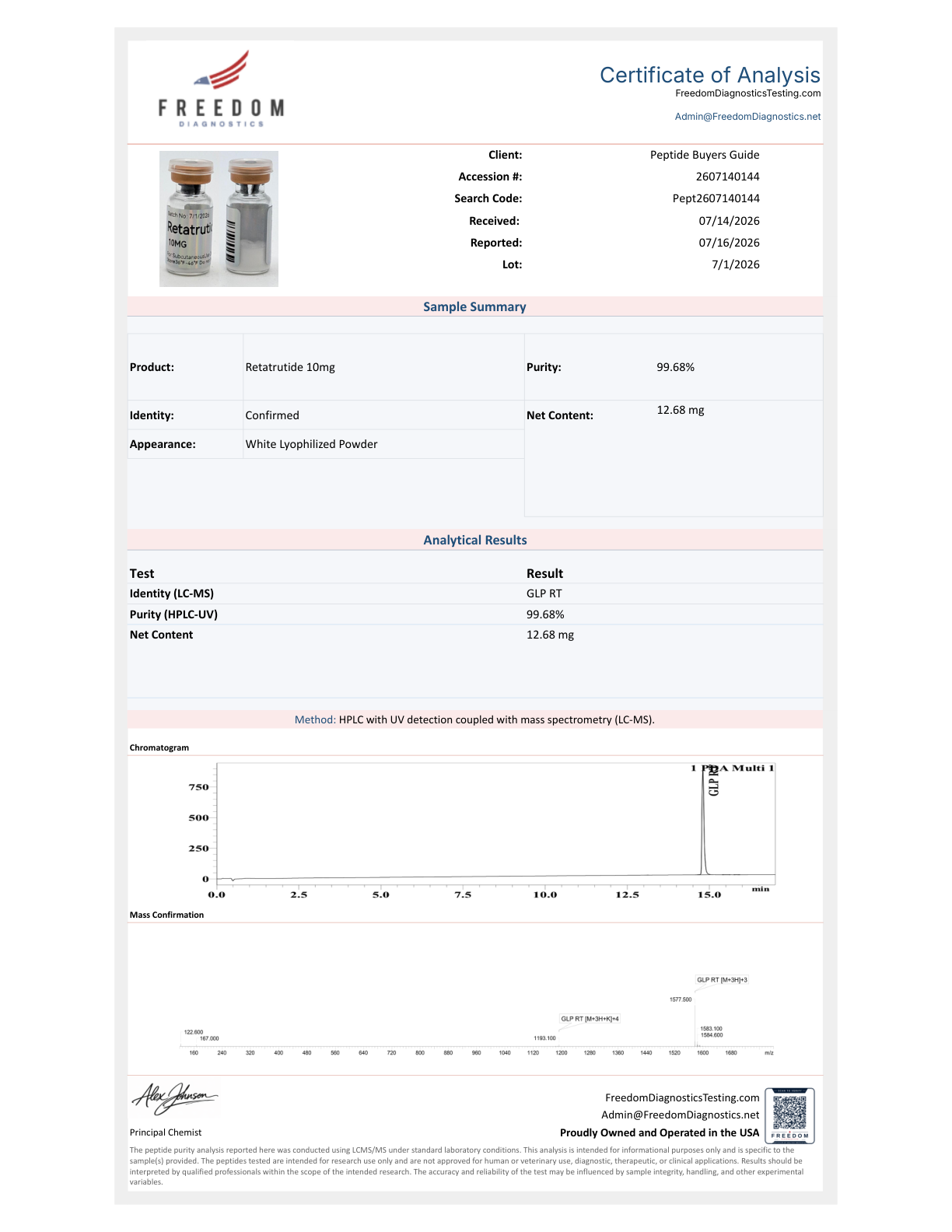
Another vial from the same kit had already been tested by Freedom Diagnostics. Freedom identified that vial as retatrutide and measured its net content at 12.68 mg. These were different vials from the same kit, so the Freedom result is not an exact vial-to-vial quantity comparison. It does, however, provide an important reference for what the kit contained.
Set up before the result
This challenge was set up before Midwest Diagnostic issued its report. Before sending the vial, I posted an announcement to the group explaining exactly what I was doing and why. The key part of that announcement was:
“I sent them a 10 mg vial of retatrutide, but intentionally labeled it as 20 mg tirzepatide. The point is to see whether they’re truly testing the sample or simply reporting what appears on the label.”
I also recorded myself changing the label before the sample was sent. The original announcement and the label-change video are available in the Peptide Buyers Guide Skool group, where readers can review how the challenge was prepared.
What the two reports say
Freedom Diagnostics received its vial on July 14, 2026, and reported it on July 16. Its report lists the product as retatrutide 10 mg, identity as confirmed, mass identification as “GLP RT,” net content as 12.68 mg, and purity as 99.68%.
Midwest Diagnostic received the deliberately mislabeled vial on September 4, 2026, and reported it on September 14. Its report lists the product as tirzepatide 20 mg, mass identification as “GLP TZ,” net peptide content as 20.48 mg, and purity as 99.48%.
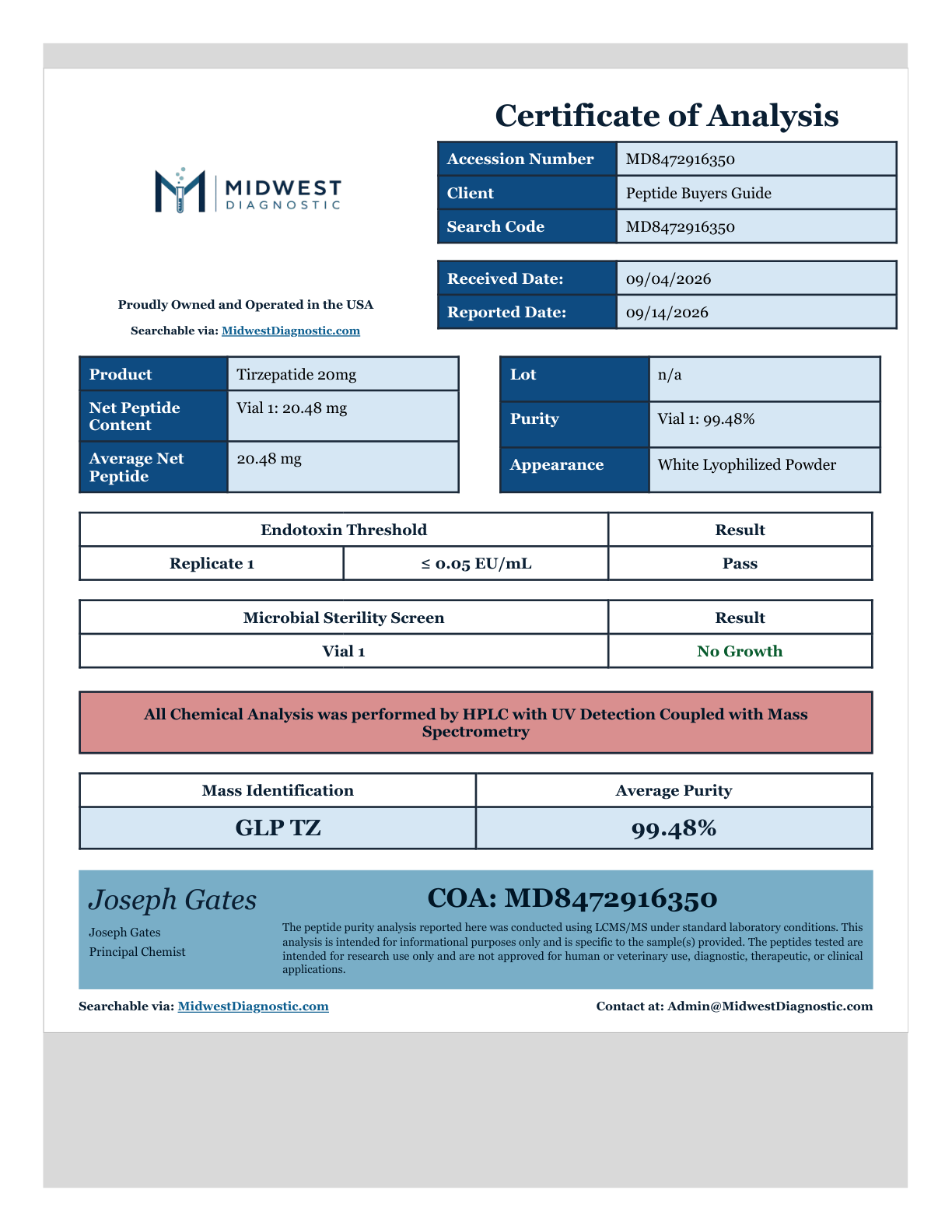
The result from Midwest was not an identity mismatch, an inconclusive result, or a warning that the sample did not match the submitted description. It was a report of approximately the product and amount written on the false label.
Why I believe Midwest failed
First, the identity should have been checked. Midwest says it used HPLC with UV detection coupled with mass spectrometry and also references LC-MS/MS. Retatrutide and tirzepatide are different molecules. If the submitted vial contained retatrutide as expected, an appropriate identity method should not have reported tirzepatide. At the absolute minimum, the laboratory should not have reported “GLP TZ” as the mass identification without supporting data demonstrating that conclusion; if its method could not distinguish the two peptides, it should have flagged the result as inconclusive.
Second, the amount should have been measured independently. A content result should come from the sample and an appropriate calibration process. It should not simply follow the amount provided on the label. The reported 20.48 mg is especially concerning because the false label said 20 mg.
Third, the purity number does not solve the problem. A sample can be highly pure and still be the wrong peptide. Reporting 99.48% purity does not establish that the material was tirzepatide, and it does not independently validate the reported amount once the identity is in doubt.
I cannot prove from the COA alone whether this happened because the label was relied upon, the sample was mixed up, the result was reported incorrectly, or the method was inadequate. But the most troubling explanation is that the label drove the report instead of the sample. I find it unacceptable that a paid independent report could present the false label description as though it had been independently verified.
My conclusion
I believe Midwest Diagnostic failed this challenge. Based on these results, I do not recommend that anyone in our group use Midwest Diagnostic for peptide testing.
I have sent Midwest Diagnostic an email outlining these concerns and asking for an explanation. I do not expect to hear back, but if they respond, I will post their response and update this page.
For more independent testing records, browse the Independent Testing Archive (PIN required).
Questions about this testing challenge
Were Freedom and Midwest testing the same vial?
No. They tested different sealed vials from the same kit. Freedom confirmed retatrutide in its vial and measured 12.68 mg. That supports our understanding of the kit, but it does not independently establish the exact contents of the vial sent to Midwest.
Could the kit have contained one incorrectly filled or packaged vial?
That remains possible, but consider what would have had to happen.
We ordered a 10 mg retatrutide kit from the manufacturer. Freedom Diagnostics tested another sealed vial from that same kit and confirmed the expected peptide, retatrutide, with a measured content of 12.68 mg.
For a random packaging mix-up to explain Midwest’s result, the vial we sent would have had to contain not simply a different peptide, but specifically tirzepatide at approximately 20 mg, the exact product and approximate amount I deliberately wrote in the incorrect description.
That would mean the kit contained an unexpected product and strength that happened to match both parts of the false description.
The alternative requires several unlikely events to occur together: an incorrectly packaged kit, a different peptide, a different strength, and a result that happened to match the false label. I cannot assign a numerical probability, but the combined coincidence is extraordinarily implausible.
Because the laboratories tested different sealed vials, we cannot completely rule out that possibility. But it deserves supporting evidence, rather than being treated as an established explanation for Midwest’s result.
Could we have sent the same sample to both laboratories?
Not through the submission process used here. These laboratories accept sealed vials, so the practical comparison was between different sealed vials from the same kit. That limitation is why the Freedom report is supporting evidence about the kit, not direct proof of the contents of Midwest’s individual vial.
Could Freedom’s result have been wrong?
That is possible too. Freedom’s report includes a chromatogram and mass-confirmation graphic, giving readers more supporting information to inspect. Its identity result also matched the product we ordered.
However, a report is not infallible. We should not treat Freedom’s result as unquestionable proof of every vial’s contents.
Did we purchase identity testing, or only purity testing?
The scope of the order matters. If a customer purchases purity-only testing, that may not include independent identity confirmation.
The certificate Midwest issued nevertheless lists “GLP TZ” under “Mass Identification” and reports net peptide content of 20.48 mg. We are questioning those reported conclusions, while recognizing that a purity-only service may not be designed to identify an unexpected compound.
Does having mass spectrometry mean a laboratory can identify any unexpected substance?
No. Equipment capability and the method actually used are different things. A laboratory may run a targeted method that looks specifically for a declared peptide rather than a broad search for unknown compounds. We do not know from the COA whether Midwest used a targeted method.
Our minimum expectation is that a claimed identity should be supported by the analysis. Identifying an unexpected substance as retatrutide is a broader task than determining that the evidence does not confirm tirzepatide.
Could a targeted tirzepatide method legitimately miss retatrutide?
It could fail to identify retatrutide if it was not configured to look for it. That is a possible limitation of a targeted method, although we have no evidence that this is what happened here.
It would not, by itself, establish that the sample was tirzepatide. Midwest would need to show what measurements supported that identification and whether its method distinguishes tirzepatide from retatrutide and other related substances.
Could shipping, storage, or sample handling explain the discrepancy?
Those are general possibilities that can affect peptide recovery, degradation, and measured purity or content. We have no evidence that any of those problems occurred here.
Ordinary degradation would not be expected to turn retatrutide into tirzepatide. A sample substitution, contamination, or handling mix-up would require evidence from the laboratory’s records.
Could Midwest have tested a sample but attached the wrong result to our submission?
Yes. An accession, sample, or reporting mix-up could explain the result without proving that no testing occurred.
That would still be a serious failure for the customer. Sample tracking records and instrument records tied to our accession number could help determine whether this happened. We do not know whether Midwest has receipt photographs or other records of that kind.
Does the 20.48 mg result prove they followed the false label?
No. It is concerning in combination with the reported identity, but the number alone does not establish how it was obtained.
Freedom measured a different vial. Differences in vial filling, preparation, calibration, or the definition of “net peptide content” could affect the comparison. We cannot claim that Midwest’s vial definitely contained exactly 10 mg or 12.68 mg.
The concern is the combination: both the reported identity and approximate amount matched the deliberately incorrect description.
Does 99.48% purity validate the identity or amount?
No. Chromatographic purity commonly describes the proportion of detected signal assigned to the main component under the chosen conditions. It does not automatically establish the compound’s identity or its milligrams per vial.
A highly pure sample can still be the wrong peptide. Identity, purity, and quantitative content require their own supporting evidence.
Does the absence of a chromatogram or mass spectrum prove no testing occurred?
No. The COA does not establish whether supporting data exist elsewhere or whether they were retained by the laboratory.
The concern is that Midwest’s certificate provides little information with which to assess its conclusions. Supporting chromatograms, mass data, reference comparisons, and quantitative calculations would help establish what was actually measured. Their absence from the certificate is a documentation limitation, not proof of fabrication.
What information would help resolve this?
The most useful information would be the chromatogram and mass-identification data tied to our sample, an explanation of the identity criteria, and the calibration and calculations supporting 20.48 mg. Sample tracking records tied to our accession number would also help investigate a possible mix-up.
We are seeking enough evidence to understand the reported results. We are not assuming the laboratory must publicly release its entire proprietary method.
Does one challenge establish the laboratory’s overall accuracy?
No. One submission cannot measure the laboratory’s overall error rate or validate every service it offers. Repeated comparisons using independently characterized samples would provide stronger evidence.
However, one serious unresolved discrepancy can reasonably affect whether we recommend a laboratory. My recommendation is based on this experience, not a statistical survey of all its testing.
Does this prove Midwest performed no testing or operated a scam?
No. The reports alone do not establish intent or prove that no testing occurred. Label reliance, an inadequate method, a sample mix-up, or a reporting error remain possible explanations.
What we have is a substantial discrepancy: Midwest reported tirzepatide at approximately the amount supplied in the deliberately incorrect description, while another sealed vial from the same kit had been identified as retatrutide, the product we ordered.
That raises serious concerns and warrants supporting evidence and an explanation.
Have we given Midwest an opportunity to explain?
We have emailed Midwest requesting additional information about the report. If they respond, we will publish their explanation and assess whether the supporting evidence resolves the discrepancy. We will correct this account if new evidence warrants a correction.
Do these hypothetical explanations change my conclusion?
No. We ordered retatrutide, and Freedom confirmed retatrutide in another vial from the same kit. Midwest then reported the exact peptide and approximate strength I deliberately supplied incorrectly: 20 mg tirzepatide.
I find that alignment extraordinarily implausible as a random coincidence. Listing hypothetical possibilities does not explain it, and none has been supported with evidence in this case.
Whether Midwest relied on the submitted description, mixed up the sample, or issued the wrong report, the certificate we received failed the purpose of independent verification. My conclusion remains firm: I do not recommend Midwest Diagnostic for peptide testing.
If Midwest provides credible analytical evidence explaining the result, I will examine it and publish an update. Until then, I have no confidence in this report.
This page records an independent testing challenge and the conclusions drawn from the two certificates provided above. It is not medical advice.